
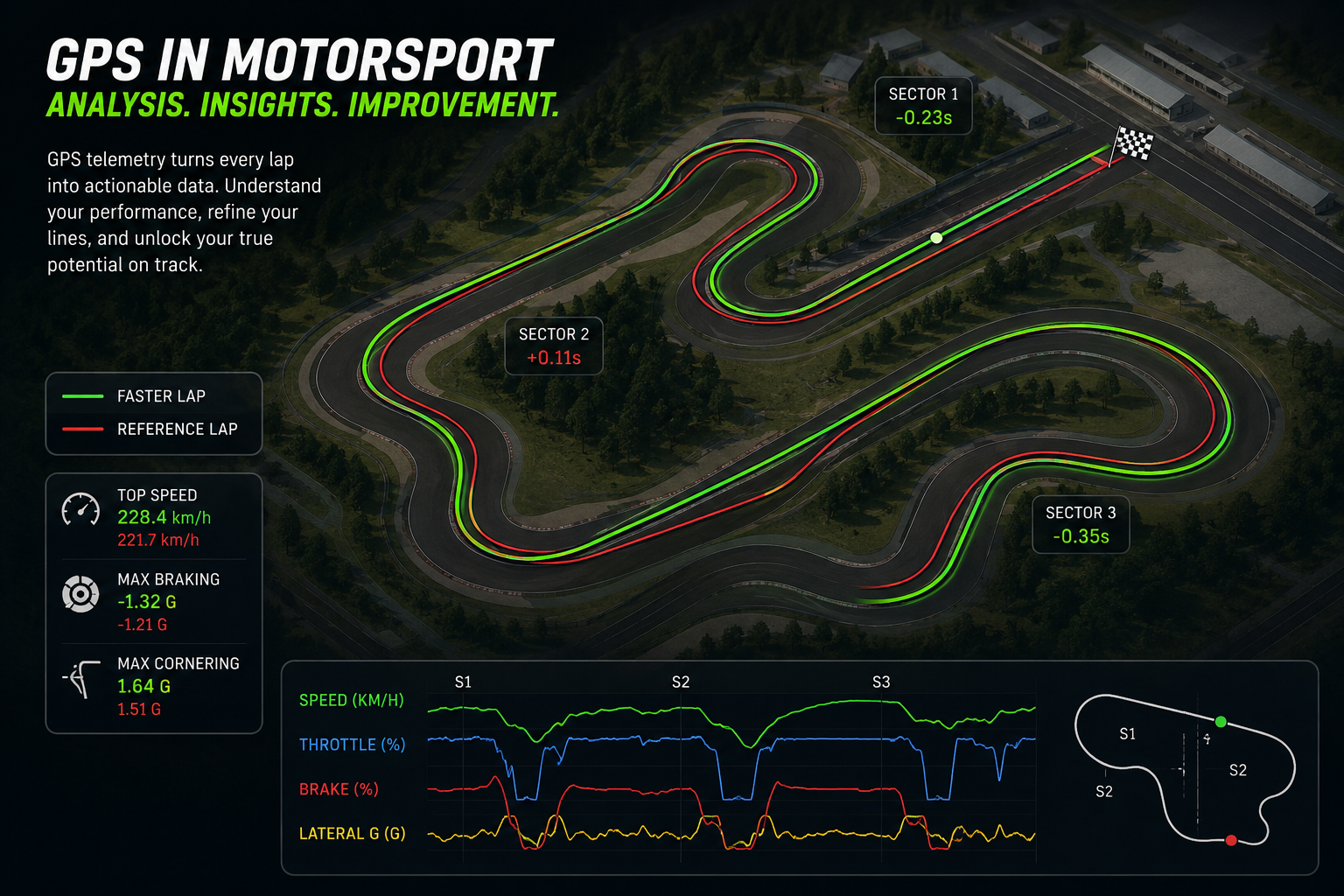
The Role of GPS in Motorsport Analysis and Development: From Speedway to WRC
Introduction
Modern motorsport is increasingly difficult to imagine without data. Results are no longer determined solely by a driver’s talent, experience, or the preparation of a motorcycle or car. The ability to accurately analyse what happened during practice, qualifying, or a race is becoming increasingly important.
One of the tools that can provide this information is GPS data. GPS technology can record a driver’s position, speed, lap or stage time, and the way individual sections of a track or route are completed. Combined with other data sources, GPS can become much more than a way of measuring performance. It can help explain why a driver or rider is faster or slower than during a previous run or compared with a more experienced competitor.
This is particularly important for beginner motorsport drivers and riders. An experienced competitor can often intuitively identify where they made a mistake. A beginner may only know that they “were slower.” GPS data can turn that general feeling into specific, measurable information.
GPS as a Development Tool, Not Just a Timing System
The simplest way to use GPS is to compare lap or stage times. However, this is only the starting point.
If a driver completes a lap in 2:15 and then improves to 2:13, we know that the result has improved by two seconds. We do not yet know, however, where those two seconds came from.
GPS analysis can show that the driver:
- braked later before a corner,
- started accelerating earlier,
- maintained a higher speed through a particular section,
- chose a different racing line,
- reduced time loss in a specific corner, or
- became more consistent from one lap to another.
For a coach, this is extremely valuable. It makes it possible to move from evaluating the result to analysing the process that produced it.
What Can GPS Tell Us About a Beginner Motorsport Driver?
For a driver or rider at the beginning of their career, GPS data can primarily be used to monitor progress.
The goal is not simply to become faster. Consistency, smoothness, and the ability to follow a planned driving strategy are equally important.
For example, a beginner WRC driver may complete a particular corner very quickly on one run, but lose several seconds there on the next. GPS analysis can help identify this difference and investigate what caused it.
The same principle applies to a beginner speedway rider. On a relatively short oval track, differences between consecutive laps can result from small changes in speed, corner entry, or corner exit. Detailed GPS analysis can therefore help identify specific areas that require improvement.
GPS in Speedway
Speedway is an interesting example of GPS application because riders compete on relatively short, closed circuits. This makes it possible to compare individual laps with previous runs and sessions.
For a beginner speedway rider, particularly useful GPS metrics can include:
- total lap time,
- sector or section times,
- speed at specific points around the track,
- differences between consecutive laps,
- racing line selection,
- corner entry behaviour, and
- corner exit performance.
Simply knowing that a rider completed a lap more slowly does not explain what needs to be improved. If the analysis shows that the largest time loss consistently occurs in one corner, the coach has a specific starting point for further training.
GPS can therefore complement traditional rider observation from the trackside or grandstands.
GPS and Driving Analysis in WRC
In rallying, the possibilities for analysis are even broader. Special stages are long and varied, containing different types of corners, surfaces, elevations, and driving conditions.
GPS allows runs to be compared both at the level of the entire stage and across individual sections.
A beginner rally driver can use the data to identify where they lose time compared with an earlier run or a more experienced driver.
For example, analysis may show that a driver is highly competitive on fast sections but consistently loses time in tight hairpins. Training can then focus specifically on that element.
This represents an important change in the approach to training. Instead of practising everything equally, attention can be directed toward the specific driving skills that have the greatest impact on performance.
The Most Important Factor Is Not Speed Alone, but Context
One of the biggest mistakes when interpreting GPS data is focusing exclusively on maximum speed.
Higher speed does not always mean better driving.
In motorsport, it matters where a particular speed is achieved, how long it is maintained, and what happens before and after that point.
A driver may have a lower maximum speed but, because of a better corner exit, complete the following section faster.
GPS data should therefore be analysed in the context of the entire run rather than as a collection of individual numbers.
Comparing One Driver With Another
GPS data can also be used to compare the performance of two drivers or riders.
For a beginner, however, the most valuable first comparison is often with themselves.
Comparing today’s run with one from a month earlier can reveal genuine development. This may be more meaningful than directly comparing a beginner with a competitor who has many years of experience.
Only after establishing the driver’s own progress should the analysis move toward identifying differences between the beginner and more experienced competitors.
GPS Combined With Other Motorsport Data
GPS does not have to work independently.
In professional motorsport, GPS analysis can be combined with:
- telemetry,
- speed measurements,
- engine RPM data,
- throttle position,
- braking data,
- video footage,
- sensor data, and
- driver or rider communication with the team.
Combining these sources can create a much more detailed picture of a run.
GPS can therefore become one part of a broader motorsport performance analysis system.
GPS Data and the Coach’s Role
The greatest value of GPS data is not in the device itself, but in how the information is interpreted.
A beginner may be given a graph showing speed throughout a lap and have no idea what to do with it. An experienced coach, however, can use the same graph to create a specific training objective.
This is where data analysis becomes practical. The goal is not simply to collect more information, but to turn information into actionable feedback.
Can GPS Replace a Coach?
No.
GPS can provide a great deal of information about what happened during a run, but it cannot always explain why a driver or rider made a particular decision.
Interpreting the data requires experience, knowledge of the discipline, and the ability to combine GPS information with direct observation and the driver’s own feedback.
The best results therefore come from combining technology with human expertise.
GPS provides the data.
The driver or rider provides feedback and sensations from the vehicle.
The coach interprets both sources and turns them into a training plan.
Conclusion
GPS can be a highly valuable tool in the development of a beginner motorsport driver or rider. In both speedway and rallying, it allows performance to be analysed in much greater detail than simply measuring lap or stage time.
However, the greatest benefit does not come from recording data alone. Its real value appears when the data helps answer specific questions:
Where is the driver losing time? Why is the time being lost? What is different about the faster run? What should be changed during the next training session?
For a beginner, this approach can significantly accelerate the learning process. Instead of relying solely on intuition and general observations, development can gradually become based on measurable information.
GPS cannot replace talent, experience, coaching, or hard work. It can, however, make every training session more informed, measurable, structured, and focused on specific areas of driver development.
