
AI in Motorspor: It’s Changing Racing and Speedway
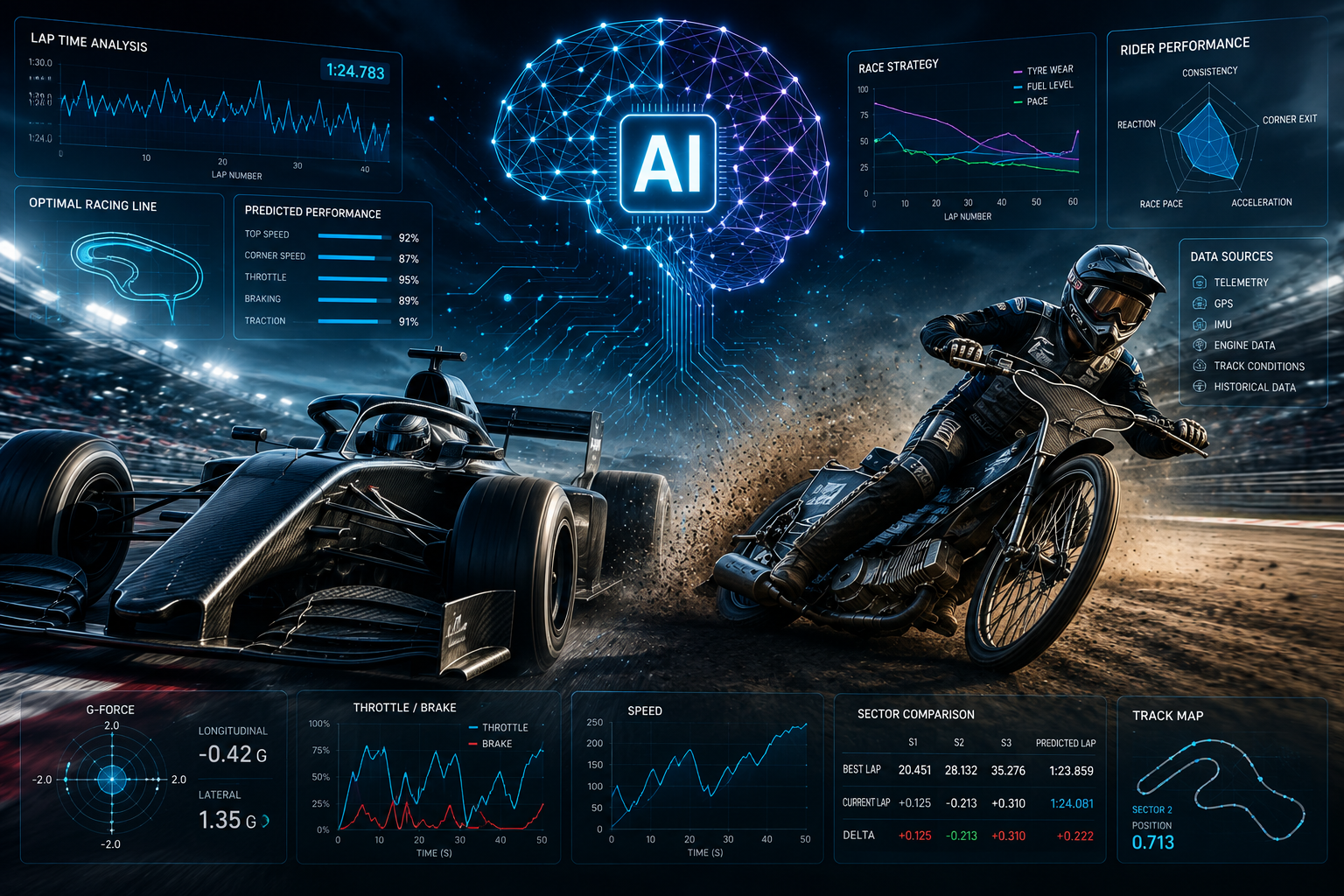
AI in motorsport is becoming increasingly important in modern racing and speedway. It helps analyse data, predict driver and rider behaviour, identify optimal strategies and process information that would be impossible for a human to analyse in such a short period of time.
This does not mean that a computer is beginning to “know” who will win a race. In motorsport, AI is primarily a tool for analysing probability. And this is where the biggest challenge appears – the more unpredictable the sport is, the harder it becomes to create a model that will correctly interpret reality.
AI Enters Speedway
Since the 2026 season, PGE Ekstraliga has been using the Ekstraliga AI project, developed in cooperation with CANAL+ and a team associated with the Faculty of Mathematics and
Computer Science at Adam Mickiewicz University in Poznań. The system has appeared in television broadcasts and is designed to show viewers the expected points scored by riders in individual heats. The model takes into account factors such as the rider’s level, track characteristics, starting position and the quality of the opponents. This distinction is important. Ekstraliga AI was not created to say: “this match will finish 48–42”. Its primary task is to determine how many points a particular rider should statistically score in a particular heat. In principle, it works somewhat like models known from other sports, such as xG in football.
Where Does the Model Get Its Knowledge?
Creating such a system requires enormous amounts of data. In the case of Ekstraliga AI, all PGE Ekstraliga matches from 2012 to 2025 were used. That amounts to nearly 15,000 heats, almost 1,000 matches and more than 300 riders. Thanks to this, the model can search for patterns that are not immediately visible during a broadcast. The problem is that even 15,000 heats do not mean that the model “knows” every possible scenario. Speedway is a sport in which enormous importance is placed on factors that are difficult to record in simple tables. A rider’s form can change from week to week. A motorcycle can perform completely differently from the previous match. The track may be prepared slightly differently. There may be rain, a change in temperature or a mechanical problem. The model sees the data.
Therider sees reality.
The First Problem – Data Does Not Always Tell the Whole Story
This is one of the fundamental problems with using AI in sport. A model can be very good at analysing the past, but the future does not necessarily have to look exactly the same.
If a rider has achieved excellent results on a particular track for three seasons, the model will have good reasons to rate their chances highly. However, it does not know that the rider changed the motorcycle’s setup that day, has an engine problem or is simply having a worse day. It may only take some of this information into account once it appears in the data.
This is exactly why AI should not be treated as an oracle. It is only as good as the data it receives and the way it has been designed.
Speedway Makes the Task Particularly Difficult
In speedway, the problem is even greater. A race is very short, riders compete on a track whose characteristics can change from heat to heat, and starting from a particular gate can be extremely important. On top of that, there is the motorcycle, its setup, the choice of racing line and the rider’s reaction to the situation on the first corner.
The model may say that a rider has a high expected probability of scoring three points. That does not mean it knows how the rider will start a few seconds later.
And those few seconds can decide the outcome of the heat.
When Does AI Start to Look Flawed?
The biggest problem appears when the model’s result is presented to fans as a certain prediction. Then every major difference between the prediction and reality looks like an embarrassment for artificial intelligence.
A good example was the match between Orlen Oil Motor Lublin and PRES Grupa Deweloperska Toruń at the beginning of the 2026 season. Before the nominated heats, the system even indicated the possibility of a close 39–39 score, while the match ended with Motor winning by as much as 50–28.
Jacek Frątczak pointed out, among other things, the problem of insufficient amounts of up-to- date data at the beginning of the season and the need for further “training” of the model.
Does that mean AI got it wrong? Yes.
Does that mean the model is worthless? No.
These are two completely different things.
AI Does Not Have to Predict the Result to Be Useful
Imagine that before a heat, the model gives a rider an expected score of 2.4 points. This does not mean that the rider will “score 2.4 points”. It is a statistical value. In reality, they may score three, two, one or zero.
However, if a model can correctly identify, across hundreds or thousands of cases, which riders statistically have a greater chance of achieving a good result, it can be a very valuable analytical tool.
The problem arises when fans start treating the expected value as a prediction.
It Is a Bit Like xG in Football
A similar mechanism has existed in football for years. xG, or expected goals, measures the quality of scoring opportunities and the probability of a goal being scored.
If a team has 2.5 xG, that does not mean it “should score exactly 2.5 goals”. It can win 4–0, lose 0–1 or draw 1–1.
So why is xG useful? Because over a dozen or several dozen matches, it helps provide a better assessment of whether a team’s results correspond to the quality of the chances it creates.
Ekstraliga AI is trying to do something similar with speedway – bringing statistical analysis down to the level of individual heats and riders.
The Problem Is the Human Looking at the Number
Paradoxically, one of the biggest problems with AI in sport may not be the algorithm itself. The problem may be the way its result is presented.
If the number “2.7” appears on the screen, a fan may interpret it as a prediction. In reality, it
is an expected value resulting from a statistical model. That is a huge difference.
AI is not saying: “the rider will score three points”.
AI is saying something closer to: “based on historical data and the factors taken into account, this result is more likely for this rider than the alternatives”.
In motorsport, where a single mistake at the start can completely change a heat, the difference between these two statements is enormous.
Can You Predict the Unpredictable?
This is the biggest challenge for artificial intelligence in motorsport. The more data a model receives, the better it can recognise patterns. That does not mean it will be able to predict every possible situation. What happens if a rider is pushed wide on the first corner? What if their motorcycle suddenly begins to lose power? What if the track changes more than expected after two heats? What if a rider discovers a completely new racing line? For a human, these are elements of competition. For a model, they are new pieces of data that it may not have encountered before. And this is where the boundary between statistical analysis and sporting reality begins.
Formula E Shows How AI Can Be Used Differently
A very interesting example of artificial intelligence being used in motorsport is Formula E. In this case, AI can be used not only to present statistics to fans, but also to solve real strategic problems related to energy management. Electric cars have to manage a limited amount of energy throughout a race. A driver can therefore decide whether to use more energy now in order to attack a rival or save it for a later stage of the race. This is a problem in which the number of possible combinations is enormous. Research into the use of neural networks and search algorithms has shown that such solutions can be used to rapidly create strategies both before a race and when responding to unexpected situations.
This Is Where AI Really Starts to Resemble an Engineer
The difference is very interesting. In Ekstraliga AI, the main task is to determine the expected number of points scored. In Formula E, artificial intelligence can be used to solve a much more complex problem: what should be done in a given situation to increase the chances of achieving the best possible race result? This is a completely different level of technological application. AI can analyse energy consumption, pace, the behaviour of rivals and possible scenarios. It can then identify the strategy that, according to the model, offers the greatest chance of a favourable outcome. The human still makes the decision, but the computer can analyse in a few seconds variants that a person would not be able to calculate manually.
AI Will Not Replace the Rider or Driver
And that is precisely why the future of artificial intelligence in motorsport will probably not involve completely replacing humans. A model based on cooperation is much more likely. The rider provides information that is not contained in the data. The engineer interprets the
behaviour of the vehicle. The strategist analyses the situation on the track. AI processes enormous amounts of information and identifies the most likely scenarios. Each of these elements has a different function. A computer can calculate thousands of possible scenarios. It cannot, however, feel the motorcycle coming out of the first corner.
The Biggest Trap? Trusting the Number
The introduction of AI into motorsport creates another problem – a psychological one. Numbers look objective. If a specific percentage or expected number of points appears on the screen, it is easy to assume that it represents “the truth”. However, every model has assumptions, limitations and a margin of error. Good analysis should therefore not ask only: “What does AI predict?”. It should also ask: “What data is AI using to make this prediction, and what does the model not see?” This question will become increasingly important as artificial intelligence develops further in sport.
The Future of Motorsport Will Be More Digital
The direction of development is already visible. AI is being used for data analysis, race strategy, energy management, vehicle optimisation, telemetry analysis and the creation of new ways to present sport to fans. Academic reviews of AI in motorsport point to applications including performance optimisation, race strategy, telemetry analysis, driver training and predictive vehicle maintenance. Formula E is even expanding its cooperation with Google Cloud, using AI solutions in areas including race operations, technology development and the fan experience. This shows that artificial intelligence is no longer just a curiosity. It is becoming another tool in motorsport – much like GPS, telemetry and advanced sensors.
AI Can Be Wrong. And That Is Exactly Why It Is Interesting
Ekstraliga AI demonstrates one of the most important things about artificial intelligence in sport. A model can analyse thousands of pieces of data and still be very wrong about an individual match. This does not necessarily prove that it is worthless. Rather, it is a reminder that sport is not an equation in which there is always one correct answer. In speedway, a rider can have a poor start, find a different racing line, prepare the motorcycle perfectly or simply perform better than the data predicted. And that is precisely why AI should be treated as a tool that supports analysis, not as an oracle. The most interesting future of motorsport will therefore not be about asking whether humans can beat computers. It will be about what humans can achieve when they combine their own experience with the capabilities of artificial intelligence.
